
Zimbabwe
Bulawayo
Zimbabwe's second city carries its history in its name. It grew from a royal Ndebele town, keeps some of the widest streets in Africa, and hosts World Cup cricket at Queens Sports Club — the ground where a Test once ended with the scores dead level.
The city
Zimbabwe's second city, and its older heart
If Harare is Zimbabwe's capital, Bulawayo is its older heart. This is the country's second city and the centre of Matabeleland, and it does not feel like Harare at all: it is quieter, flatter, drier, and laid out on a grand scale that catches every first-time visitor off guard. For a travelling cricket fan it is the tournament's calmer stop, and one with real depth of history behind it.
The name tells you where to begin. Bulawayo comes from kwaBulawayo — loosely, "the place of the one who is being killed" — the royal town of King Lobengula, last king of the Ndebele, in the turbulent years before colonial rule. That royal past is why the city is still called the City of Kings, and it sits underneath everything else here, including the cricket.
The ground
Queens Sports Club and the level scores
Queens Sports Club is Zimbabwe's second Test ground, the one that is not in the capital. It sits in the middle of Bulawayo, an easy walk from the main hotels, and it is a proper club ground rather than a stadium: a pavilion, grass banks and boundary-edge seats, the kind of place where you sit close to the game rather than above it.
Its most famous day came in December 1996. Zimbabwe and England played out the first Test in the history of the game to finish with the scores exactly level — England ended on 204 for 6, needing 205, the match a draw by the width of a single run. It produced one of cricket's best-known post-match lines and it is still the first thing many fans associate with this ground.
Queens is a confirmed venue for Cricket World Cup 2027. Its exact capacity is quoted differently in different places and Zimbabwe Cricket has flagged upgrades for the tournament, and the fixture list has not been published, so treat both the number and the schedule as provisional and follow the official ticket and fixture information as it is confirmed.
Match day
A warm, walkable day out
Because Queens is central, a match day here is refreshingly simple. Most visitors stay in the CBD within walking distance of the ground, or a few minutes away in the nearer suburbs, so there is little of the long stadium commute you get in the bigger host cities. The scale is human: short queues, easy movement, and a crowd you feel part of.
Time it for heat. October and November are the hot, dry weeks before the rains, and Bulawayo sits high enough — a little over 1,300 metres — that the sun is stronger than the air temperature suggests, even if the altitude keeps nights pleasant. A hat, sunscreen, water and a plan for afternoon shade will do more for your day than almost anything else.
The city
The widest streets you'll walk
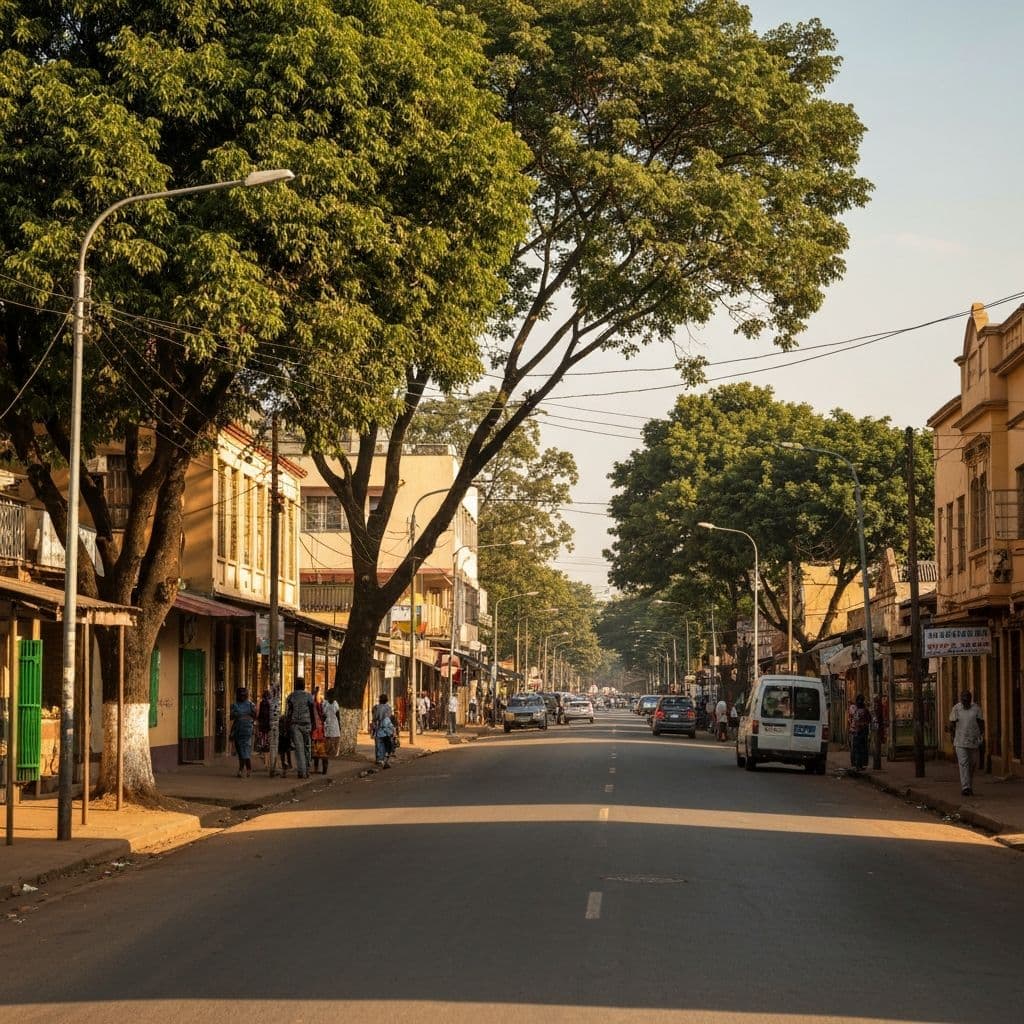
The first thing you notice in central Bulawayo is the width of the streets. The city was laid out in the 1890s on a generous grid, and the enduring local story is that the main roads were made broad enough to turn a full span of oxen — a wagon and team — without having to reverse. Whether or not every detail holds up, the effect is real: broad, straight, low-rise avenues that give the centre a calm, unhurried openness.
That grid is lined with some of the best-preserved early-twentieth-century architecture in the region, and the city wears it plainly rather than as a showpiece. Walking the CBD by day is the simplest way to read Bulawayo: the scale, the shopfronts and the quiet tell you a lot about a place that was built to be Matabeleland's working capital.
Railways & arts
A railway town with a music habit
Bulawayo grew up as Zimbabwe's railway city, the junction where lines from South Africa, the coast and the interior met, and that history is still visible. The Bulawayo Railway Museum keeps old steam locomotives and carriages from that era, and it is a genuinely absorbing hour even if trains are not your thing — it explains how this particular city came to exist.
The other side of Bulawayo is its arts scene. The city has a long reputation for jazz, mbira and theatre, and it hosts some of the country's best-known cultural events. Spots like the Indaba Book Café sit at the centre of that, mixing live music with a place to sit and read the city. It gives Bulawayo an evening character that is more listening than clubbing.
Neighbourhoods
Where to base yourself
City centre (CBD)
The obvious base for cricket. Long-standing hotels sit within walking distance of Queens Sports Club, and the wide grid makes moving around on foot by day straightforward.
Hillside
A leafy residential suburb south-east of the centre, with guesthouses and B&Bs. Quieter than the CBD and an easy short drive in for matches.
Burnside
Further out and greener still, on the way towards the hills. Good for larger self-catering stays if you have a car and want space rather than a central location.
Matobo lodges (out of town)
Not a place to sleep on match days, but if you are building a safari around the cricket, the granite-country lodges south of the city make a striking base with a longer run in.
Food
Sadza, steaks and slow mornings
The staple to try is sadza — a thick maize-meal porridge — eaten with grilled or stewed meat and greens, and it is best somewhere busy and local rather than in a hotel dining room. Bulawayo is cattle country, so a good steak is easy to find, and the braai (a grill over coals) is as much a social occasion here as a meal.
By day the city has an unhurried cafe culture that suits its pace, from the arts-minded Indaba Book Café to old-establishment dining rooms like the Bulawayo Club. It is not a big restaurant city, but what it has, it does without fuss — which is very much the Bulawayo way.
Beyond the ground
Granite hills and onward roads
Bulawayo's signature landscape is the Matobo Hills, about an hour south — a UNESCO World Heritage site of balancing granite boulders, some of the richest San rock art in the region, black and white rhino on foot with a guide, and the hilltop grave of Cecil Rhodes at the viewpoint he called World's View. It is the single day trip that most defines a visit here. Closer in, the Khami Ruins — a stone-built royal city and another World Heritage site — are about half an hour west.
The city is also a springboard for the wider country, though distances are real. Hwange, the country's largest national park, is two and a half to three hours away, and Victoria Falls is around five hours by road or a short flight. Plan those as their own legs rather than day trips. Our safari guide and Victoria Falls guide cover the onward trips in full.
Straight talk
Money, visas and getting around
Like the rest of Zimbabwe, Bulawayo runs largely on US dollars in cash. Bring clean, undamaged notes in small denominations — ones, fives, tens and twenties — because change can be hard to come by and cards are accepted only at some hotels and larger businesses. Cash machines are unreliable, so do not plan to withdraw your way through the trip; arrive with what you need.
Most visitors get a visa on arrival at Joshua Mqabuko Nkomo International Airport, about 22 kilometres north of the centre and 25 to 30 minutes by road. If you intend to pair the cricket with Victoria Falls, the KAZA UniVisa covers Zimbabwe and Zambia and allows day trips into Botswana. Fees and rules change, so confirm the current terms before you fly and see our visa guide for the detail.
For getting around, arrange transfers through your accommodation or hire a car with a driver; ride-hailing exists but is limited, so do not rely on it. Bulawayo has a reputation as one of the calmer, friendlier cities in the region — the CBD is comfortable to walk by day — but take the usual sensible steps at night, use booked transport, and keep your passport secured with a copy on you.
Bulawayo Travel Guide: Frequently Asked Questions
Everything you need to know about visiting Bulawayo for a cricket trip — from airport transfers to match day experiences.
Why visit Bulawayo for the Cricket World Cup 2027?
Bulawayo is Zimbabwe's second city and the heart of Matabeleland, and it carries its history in its name: it grew from kwaBulawayo, the royal town of King Lobengula of the Ndebele. For cricket it matters as the country's second Test ground — Queens Sports Club, where the 1996 Test against England ended with the scores level, one of the most famous finishes in the game. The city is calmer and slower than Harare, known for its very wide streets, its railway past and a strong arts and music scene, with the granite Matobo Hills about an hour to the south.
How do I get from Joshua Mqabuko Nkomo International Airport to Bulawayo?
Joshua Mqabuko Nkomo International Airport (BUQ) is about 22km north of the city centre, roughly 25 to 30 minutes by car. It has connections to Harare, Johannesburg and Victoria Falls. A hotel transfer arranged in advance is the most reliable way in; taxis are available but agree the fare before you set off. Ride-hailing is limited, so do not count on it. Car rental is an option if you plan to explore the region.
Where is Queens Sports Club and how do I get there?
Queens Sports Club sits in central Bulawayo, within an easy walk of the main CBD hotels. It has been a Test ground since October 1994 and is best known for the drawn 1996 Test against England that ended with the scores level. Published capacity figures vary — you will see numbers from around 9,000 up to about 12,000 — and Zimbabwe Cricket has said upgrades are planned for the tournament, so treat any single figure as provisional. Its central position makes getting there straightforward from anywhere in town.
What are the key distances from Bulawayo to major attractions?
Bulawayo sits within reach of several major sites. Matobo Hills, with its San rock art and rhino tracking, is about an hour south. Khami Ruins, a UNESCO World Heritage site, is around 30 minutes west. Hwange National Park, Zimbabwe's largest, is roughly two and a half to three hours away, and Victoria Falls is about five hours by road or a short flight. These are best planned as separate days rather than squeezed around a match.
| Destination | Distance | Travel Time |
|---|---|---|
| Matobo Hills (UNESCO) | 45km | 45 min |
| Hwange National Park | 270km | 3 hours |
| Victoria Falls | 440km | 5 hours |
| Harare | 440km | 5 hours |
| Khami Ruins (UNESCO) | 22km | 30 min |
What are the best transport options in Bulawayo during the Cricket World Cup 2027?
Bulawayo is compact and easy to walk, and the CBD is fine on foot during the day. For Matobo Hills and Hwange you will want an organised tour or a hired vehicle with a driver. Ride-hailing exists but is limited, so do not rely on it; taxis are available and hotels can recommend trusted drivers. Car rental works if you are comfortable driving on the left. Inter-city buses link Bulawayo with Harare and Victoria Falls.
- Walking (CBD)
- Hotel transfers
- Hired car with driver
- Organised tours (for safari)
- Car rental
- Inter-city buses
What is the weather like in Bulawayo during the Cricket World Cup 2027?
October and November are the hot, dry end of the season before the rains arrive. Expect daytime temperatures of about 28 to 35°C (82 to 95°F), the warmest time of the year, cooled a little by the city's altitude. Later in November you may catch an afternoon thunderstorm. The dry conditions also make it a strong time for wildlife at Hwange, where animals gather at the waterholes.
What are the best areas to stay in Bulawayo for the Cricket World Cup 2027?
Bulawayo is smaller and easier to get around than Harare. The CBD has long-standing hotels within walking distance of Queens Sports Club, which suits match days. The suburbs of Hillside and Burnside are quieter, with guesthouses and B&Bs. If you want to build a safari around the cricket, lodges in Matobo Hills or near Hwange can work as a base, though they mean a longer run in for matches.
Walking distance to stadium, historic hotels, restaurants
Quieter residential areas with B&Bs and guesthouses
Lodge accommodation, 45 min from city, wildlife, rock art
Safari lodges, 3 hours from city, Big Five experiences
What are the higher-end places to stay near Bulawayo?
In the city itself, top-end options are limited; the best-known character stay is Nesbitt Castle. Most of the region's premium lodging is out in the bush. Matobo Hills has well-regarded lodges such as Amalinda and Big Cave Camp, set among the granite. Hwange's high-end camps, like Somalisa and Little Makalolo, are full safari lodges with game drives and meals included. Victoria Falls, about five hours away, has the widest choice of upmarket hotels.
What is the cost difference between budget and premium stays in Bulawayo?
Bulawayo is good value by regional standards. Budget guesthouses and city hotels start around $40 to $70 a night. Mid-range rooms in the CBD or suburbs run roughly $80 to $150. Matobo Hills lodges are usually $200 to $400 a night with activities included. Hwange safari lodges are the top of the range, from about $400 to over $1,000 per person sharing, covering game drives and meals.
What are the best restaurants in Bulawayo for Cricket World Cup visitors?
Bulawayo's food scene mixes long-established places with newer cafes. The CBD has sit-down restaurants near the ground, while Hillside leans to casual dining. The plate to try is sadza with grilled meat (nyama), best at a busy local spot rather than a hotel. The city also has a good cafe culture for coffee and lighter meals.
What is the nightlife like in Bulawayo during the Cricket World Cup?
Bulawayo's evenings lean on its arts and music side rather than big clubbing. The city has a long jazz and mbira tradition, and Indaba Book Café is a hub for live performances. The CBD has a handful of bars, and on match days fans tend to gather at local pubs. Expect a quieter, more music-led night out than Harare, in keeping with the city's arts reputation.
- Indaba Book Café (live music)
- CBD bars
- Hillside pubs
- Jazz clubs
- Cultural events
Is Bulawayo safe for Cricket World Cup 2027 visitors?
Bulawayo is considered safer and more relaxed than Harare. The compact CBD is walkable during the day. People are known for being friendly and helpful — 'Bulawayo hospitality' is a genuine thing. Normal precautions apply at night. The political situation is stable. Carry USD cash as payment systems can be unreliable.
Safety Tips
- Generally safer than Harare
- CBD walkable during day
- Friendly locals happy to help
- Use transport at night
- Carry USD cash
- Book safari logistics in advance
What is the cricket atmosphere like at Queens Sports Club?
Queens is a club ground rather than a big arena, so the mood is close and unhurried, with spectators near the boundary and grass banks in play. It is a ground that knows big Test history — the tied-scores 1996 match against England was played here — and Bulawayo crowds are warm and knowledgeable rather than rowdy. On a match day expect braai smoke, local beer and easy conversation, at a measured Matabeleland pace rather than a stadium spectacle.
What experiences are near Bulawayo for Cricket World Cup visitors?
Bulawayo works well as a base for a few days either side of the cricket. Matobo Hills, about an hour south, has San rock art, rhino tracking and the granite hilltop where Cecil Rhodes is buried. Hwange, Zimbabwe's largest national park, is around two and a half to three hours away and is known for its elephants. Victoria Falls is roughly five hours by road or a short flight, and the Khami Ruins are a half-hour out of town.
UNESCO site — San rock art, rhino tracking, Rhodes' grave
Zimbabwe's largest park, known for its elephant herds
One of the world's great waterfalls; activities on the river
UNESCO World Heritage Site, a stone-built royal city
Wildlife rescue centre, good for families